
GYM PROGRAM FOR GOLFERS
In this gym program designed for golfers, I have included the rationale behind each exercise, along with general guidelines for following the program. I also explain the transfer effect to golf performance and why I specifically recommend these exercises.
The Goal: A Functional Whole
As in every sport and athlete coaching process, this program should ultimately be individualized according to each athlete’s specific needs. As mentioned with the previous program as well, many golfers will likely benefit from this one. However, when designing a customized program, weaknesses, strengths, limitations, body proportions, and other factors affecting performance should always be assessed.
For example, in the case of lower back pain in golfers, the first step should always be determining the root cause of the issue (there is always a reason, and it is certainly not the same for every player). Treatment and rehabilitation should then be based on that specific cause. The same generic instructions do not apply to everyone, especially not in golf, and in my opinion, not in any sport.
General Considerations
1. Force Production from the Ground (Ground Reaction Force)
Clubhead speed is generated from the ground upward. Squats and deadlifts can help develop this quality.
2. Force Transfer Through the Kinetic Chain
Golf is a classic example of a kinetic chain:
legs → hips → core → upper body → club
A weak link in the chain leads to energy leaks and reduced power output.
3. Injury Risk
Adequate strength helps the body tolerate repetitive rotational loading.
The bench press is not a particularly golf-specific movement for improving swing performance, and maximal strength alone does not directly correlate with clubhead speed. In fact, excessively heavy and slow strength training may even impair speed qualities.
In golf, the decisive factors are rotational speed, segmental timing, mobility (especially thoracic spine and hips), and the ability to produce force QUICKLY.
Basic strength work (squat/deadlift) provides a good foundation, but power production combined with rotation creates effective swing performance.
Therefore, a golf training program should always include:
- Heavy compound lifts (though not in the leading role)
- Explosive training (throws, jumps)
- Rotational power (medicine ball work, cable rotations)
- Anti-rotation and control work
Golfers benefit greatly from lower-body strength, but the key factor is how efficiently that force is converted into speed and rotation, as I also discussed in Part 1 of this article.
In Summary, Golf Training Should Combine:
- Basic strength (squat, deadlift → foundation)
- Explosive force production (jumps, throws)
- Rotational power (medicine ball, cables)
- Anti-rotation and control
- Mobility (hips, thoracic spine)
And above all:
- Transfer effect to the sport itself
What Is the Purpose of the Exercise and How Is It Achieved
The goal of training should not be the movement itself, but rather the purpose behind the movement:
force production / control / timing / transfer effect, or all of them together.
Progressing too quickly with load should be avoided, because the body first needs time to learn control and proper movement mechanics. Only once the full movement pattern is controlled and technically sound should additional load be introduced.
Secondly, strength without control should be avoided. Otherwise, one may become strong without being able to use that strength effectively and purposefully.
On the other hand, movements should not become too standardized either, as the nervous system benefits from new information and challenges.
An upper-body-dominant swing approach often becomes problematic because force production and movement control do not begin from the upper extremities.
So How Should a Good Movement Be Performed?
Controlled, but with speed.
Control should be established first, power comes after that.
Focus should remain on a clear kinetic chain:
legs → hips → upper body
Time must also be given for proprioceptive feedback to develop. One important sign of improvement is that the swing genuinely feels good, not just that it looks technically correct.
Training should include APPROPRIATE variation so that the nervous system learns movement execution, control, and coordination more effectively.
The core idea is not merely exercises for golf, but rather developing the nervous system and force production capacities for golf.
Summary
A golfer does not simply need more strength.
They need:
- Faster force production
- Better-timed force production
- The ability to transfer force through the kinetic chain without energy loss
The golf swing is not a maximal strength performance, but rather a neurologically timed event. This is where major differences between players emerge.
In later articles, I will discuss how introducing error signals into training and incorporating variation can accelerate motor learning and skill acquisition.
Golf Gym Program (2–3x/week)
Main Structure of Every Session
- Activation + mobility
- Explosive / speed work
- Strength
- Rotation / anti-rotation
- Supportive exercises
WORKOUT A (Lower Body + Rotation)
1. Activation
Hip Openers + Thoracic Spine Rotations
Hip and thoracic spine mobility drills are not merely stretching exercises, but neurological tasks in which the body learns to separate the roles of the lower and upper body. This separation is one of the fundamental mechanisms of an efficient golf swing.
Proper Execution
- Controlled movement, not rushed stretching
- Separate hip and thoracic movement
- Calm breathing
- Controlled range of motion
Avoid
- Lower-back compensation
- Fast swinging motions
- Excessive range without control
Golf Application
Better segmental separation → improved swing separation (hips vs. torso)
Learning to separate upper and lower body movement helps create a properly timed kinetic chain during the swing. Rotational mobility also improves, especially through thoracic rotations.
Glute Bridge 2×12
Proper Execution
- Drive hips upward using the glutes
- Keep ribs down (avoid hyperextension)
- Hold 1–2 seconds at the top
- Actively squeeze the glutes
Avoid
- Lower-back hyperextension
- Using hamstrings or lower back excessively
- Fast bouncing repetitions
Golf Application
Glute activation = pelvic control during the swing
Force transfer in the golf swing partly originates from the hip extensors, particularly the glutes, making their activation beneficial for the entire swing.
Dead Bug / Bird Dog 1–2×5/side
Proper Execution
- Slow, controlled movement
- Neutral spine
- Opposite limbs move in a coordinated manner
- Core stabilizes the movement
Avoid
- Lower back lifting or excessive arching
- Rushing the movement
- Pelvic rotation
Golf Perspective
Anti-rotation control = swing stability
By anti-rotation, I mean controlling excessive rotation so that stability and movement control remain efficient and purposeful.
2. Explosive Work
Medicine Ball Rotational Throw 4×4/side
Proper Execution
- Rotate torso backward
- Throw the ball laterally against a wall or to a partner
- Generate movement from the legs
- Force from the ground, not just the arms
- Fast but relaxed movement
Avoid
- Throwing only with the arms
- Lack of weight transfer
- Excessively slow movement
- Losing balance after the throw
Golf Perspective
Explosiveness + kinetic chain
The golf swing requires explosive initiation combined with proper kinetic chain activation timing.
Box Jump (or Broad Jump) 3×3
Proper Execution
- Begin from a controlled semi-squat
- Explode using the lower body
- Land softly through the full foot
- Maintain core stability
Avoid
- Crashing into the landing
- Knees collapsing inward
- Pushing only through the toes
- Excessive depth losing tension
Golf Perspective
Landing control = ability to absorb force during the swing
Both golf and jumping require rapid force production combined with rotation and control.
3. Strength (Main Lift)
Trap Bar Deadlift OR Romanian Deadlift 3–5 x 3–6
Proper Execution
- Neutral spine
- Controlled hip hinge backward
- Full-foot contact
- Controlled lift
Avoid
- Rounded back
- Excessive knee dominance
- Jerking the weight upward
- Loss of control at the bottom
Golf Perspective
Force from the ground → more power in the swing
Deadlifting here is included not for maximal strength itself, but for neurological force production.
4. Single-Leg Strength
Bulgarian Split Squat 3×6–8/leg
Proper Execution
- Front leg does the work
- Slight forward torso lean while remaining neutral
- Knee follows the toes
- Controlled descent and ascent
Avoid
- Knee collapsing inward
- Excessive assistance from rear leg
- Upper-body rotation
- Dropping down without control
- Using the lower back excessively
Golf Perspective
Weight transfer + single-leg control during the swing
The transfer effect to golf is greater than with purely bilateral training alone.
5. Rotation / Anti-Rotation
Fast Cable Rotation 3×6/side
Proper Execution
- Movement initiated from the hips
- Chest follows with slight delay
- Controlled speed
- Stable stance and balance
Avoid
- Arm-dominant pulling
- Hips and upper body moving simultaneously
- Excessive load reducing speed
- Hyperextension at the finish
Golf Perspective
X-factor stretch + sequencing
The X-factor plays a major role in the golf swing. Developing it, especially through elastic force production, can improve swing performance.
OR Landmine press
Pallof Press 3×10
Proper Execution
- Tall posture
- Light core tension
- Controlled press forward
- Resist rotation throughout the movement
Avoid
- Rotating with the movement
- Lower-back arching
- Excessive breath holding
- Swaying with the weight
Golf Perspective
Ability to resist rotation = ability to maintain structure, control, and balance during the swing.
6. Nordic Hamstring
WORKOUT B (Upper Body + Control)
1. Activation
Scapular Stability Drill
Proper Execution
- Controlled scapular movement
- Relaxed shoulders
- Small controlled range
- Focus on muscular sensation
Golf Perspective
Shoulder control = club control
Band Pull-Apart 2×15
Proper Execution
- Arms extended forward
- Pull through the shoulder blades
- Stable chest position
- Slow control
Golf Perspective
Postural control during the swing
Good posture creates an optimal environment for efficient force transfer.
Thoracic Rotation (“Open Book”)
Golf Perspective
Upper-body mobility is extremely important in golf.
2. Explosive Work
Medicine Ball Chest Pass 4×4
Golf Perspective
Upper-body force production + rapid impulse generation
Rotational Scoop Throw 3×4
Golf Perspective
Kinetic chain + timing
The golf swing relies on efficient force transfer from the ground through the hips into the upper body and ultimately the club.
3. Strength (Push)
Bench Press OR Dumbbell Bench Press 3–4 x 4–6
Golf Perspective
Upper-body strength supports stability, not movement dominance.
I prefer dumbbells because of their stabilizing effect on the shoulder joint and their ability to improve proprioception.
4. Strength (Pull)
Lat Pulldown 3–4 x 5–8
Golf Perspective
Back control = downward swing mechanics
The latissimus dorsi contributes to shoulder internal rotation and adduction during the swing.
Bent-Over Row 3×6–8
Golf Perspective
Upper-back control = swing structure
This movement strengthens the upper back, particularly the rhomboids, which stabilize scapular movement.
5. Anti-Rotation / Core
Hanging Leg Raise OR Ab Wheel 3×8–12
Golf Perspective
Control = maintaining swing structure
Core stability creates the foundation for efficient force transfer and balance.
Farmer’s Carry 3 x 20–30 m
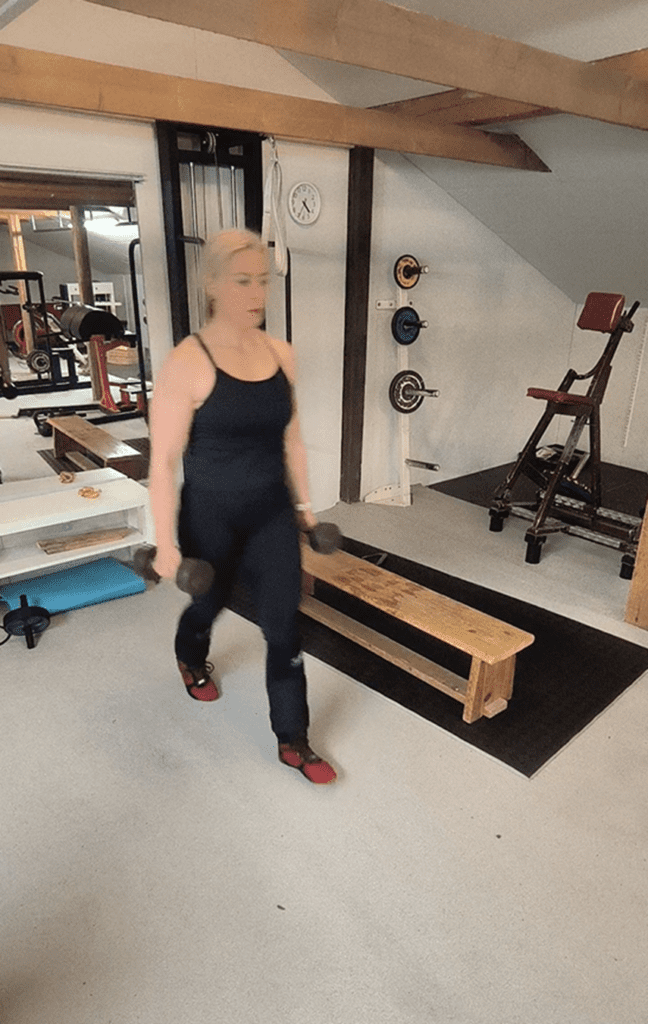
Golf Perspective
Grip strength, trunk stability, and postural control
6. Shoulder Health
Face Pull with External Rotation 2–3 x 12–15
Golf Perspective
Shoulder control = controlled club rotation
This movement supports shoulder joint health and stability.
WORKOUT C (Optional: Speed & Light Session)
This is often the missing piece:
- Light deadlift or squat performed explosively (50–60% 1RM) 5×3
- Medicine ball throws from different angles
- Cable rotations at different speeds and heights
- Mobility work
This session specifically targets clubhead speed development.
PROGRESSION (Simple Model)
- Strength lifts: increase load gradually
- Explosive work: keep repetitions low, prioritize quality
- Rotation: increase speed, not just resistance
Golf training is NOT about how much weight you lift, but how quickly and efficiently you transfer force through rotation.
How Does This Differ from Traditional Gym Training?
- Less training to complete failure
- Less hypertrophy focus
- Greater emphasis on neurological quality
- More unilateral and rotational work
In golf, the goal is not merely maximizing motor unit recruitment, but optimizing the timing and sequencing of recruitment within the kinetic chain.
Important Practical Point
- If gym training is excessively heavy → golf performance suffers
- If gym training emphasizes speed → golf performance improves
TRAINING LEVELS
🟢 BEGINNER (Coordination > Strength)
Goal
- Learn to produce force in the correct sequence
- Control rotation without energy leaks
Emphasis
- Body control
- Slower tempo
- More anti-rotation than rotation work
At this stage, the focus is NOT on chasing load, but on whether the body can transfer force efficiently at all.
🟡 INTERMEDIATE (Strength → Speed)
Goal
- Increase force production
- Begin converting strength into speed
Emphasis
- Basic strength work
- More rotational work
- Introduction of explosiveness
At this stage, it becomes evident that strength alone is no longer enough without speed.
🔴 ADVANCED / COMPETITIVE LEVEL (Power + Timing)
Goal
- Maximize clubhead speed
- Fine-tune sequencing
Emphasis
- Speed over load
- Rotation + timing
- Elastic energy utilization
At this point, the key is no longer more force, but better timing.
GYM + RANGE (The Key to Transfer Effect)
This is where many golfers fail.
Common Mistake
- Gym and golf practice remain completely separate
→ no transfer effect
Effective Model
Option A (Best)
Gym → immediately to the driving range
- Explosive exercises first (medicine ball work)
- Then golf swings
The nervous system is pre-activated, allowing speed qualities to transfer directly into the swing.
Option B
Different days, but with the same logic
- Gym session (speed + strength)
- Following day:
→ swing practice with a speed emphasis
1x/WEEK MAINTENANCE (Summer)
The goal is not to improve everything, but to maintain the most important qualities.
Priority:
- Speed
- Strength (minimum effective dose)
- Rotation

Reference
Fletcher, I. M. & Hartwell, M. (2004). Effect of an 8-week combined weights and plyometrics training program on golf drive performance. Journal of Strength and Conditioning Research, 18(1), 59–62
Jorgensen, T. P. (1970). On the dynamics of the swing of a golf club. American Journal of Physics, 38(5), 644–651.
Kwon, Y. H., Como, C., Singhal, K., et al. (2013). Effects of pelvis–torso separation on golf swing kinematics. Sports Biomechanics, 12(4), 347–360.
Lephart, S. M., Smoliga, J. M., Myers, J. B., et al. (2007). An eight-week golf-specific exercise program improves physical characteristics, swing mechanics, and golf performance in recreational golfers. Journal of Strength and Conditioning Research, 21(3), 860–869.
McLean, J. (1992). The X-factor and the golf swing. Golf Magazine.
Nesbit, S. M. & Serrano, M. (2005). Work and power analysis of the golf swing. Journal of Sports Science and Medicine, 4(4), 520–533.
Oranchuk, D. J., Storey, A. G., & Cronin, J. B. (2019). Effect of strength training on golf performance: A systematic review. Journal of Strength and Conditioning Research, 33(10), 2883–2893.